Leafwell’s licensed providers help insomnia patients explore medical cannabis as a supervised treatment option — online, same day, in most states.
- ✓Insomnia qualifies directly in New Mexico and Puerto Rico — and as a qualifying symptom in New Hampshire
- ✓In most states, patients qualify via the condition driving their insomnia — PTSD, anxiety, or chronic pain
- ✓Physician-supervised, lab-tested, state-regulated products

Key takeaways
- Insomnia is listed directly in New Mexico and Puerto Rico; New Hampshire covers “moderate to severe insomnia” as a qualifying symptom alongside a listed diagnosis
- In roughly 15 states, a licensed provider may certify any condition they determine may benefit — including chronic insomnia
- Everywhere else, the practical route is the condition driving the insomnia: PTSD, anxiety (where listed), or chronic pain
- THC at low-to-moderate doses (2.5–10 mg) reduces sleep latency and increases slow-wave (N3) sleep; high doses can increase arousal
- CBD reduces anxiety-driven wakefulness via serotonin 5-HT1A receptors — without intoxication

69%improvement in anxiety symptoms in patients with insomnia

50%better overall sleep quality reported by medical cannabis patients

10%increase in quality of life among cannabis users with insomnia
Understanding insomnia and its impact
Insomnia is the most prevalent sleep disorder in the United States, affecting an estimated 30% of adults short-term and 10% chronically. It is defined as persistent difficulty initiating or maintaining sleep — or experiencing non-restorative sleep — resulting in meaningful daytime impairment: cognitive dysfunction, mood disturbance, reduced immune activity, and elevated cardiovascular risk.
For some, insomnia is situational and resolves with the stressor. For others, it becomes chronic — at least 3 nights per week for 3+ months — requiring formal evaluation and treatment. Many manage insomnia through CBT-I, lifestyle changes, and prescription medications, but treatment responses vary widely.
When insomnia continues despite treatment
Patients may experience partial relief, persistent mid-night waking, next-day impairment, or dependency risks with Z-drugs and benzodiazepines. When insomnia persists despite conventional treatment, patients and providers may discuss additional approaches. Medical cannabis enters conversations not as a replacement but as a potential adjunct option within a supervised medical framework.
How cannabis may help insomnia
Cannabis interacts with the endocannabinoid system (ECS), which plays a direct regulatory role in the brain’s sleep-wake circuitry. Two primary compounds behave differently:
- THC (Tetrahydrocannabinol): Low-to-moderate doses (2.5–10 mg) reduce sleep latency and increase slow-wave (N3) sleep. High doses (20 mg+) can paradoxically increase arousal. [1]
- CBD (Cannabidiol): A non-intoxicating compound that reduces anxiety-driven wakefulness via serotonin 5-HT1A receptor activation and lowers cortisol — the same pathway targeted by SSRIs. Effective for secondary insomnia driven by stress or anxiety.
Dose and formulation matter significantly. Medical guidance helps patients select appropriate cannabinoid ratios and delivery methods for their specific sleep presentation.
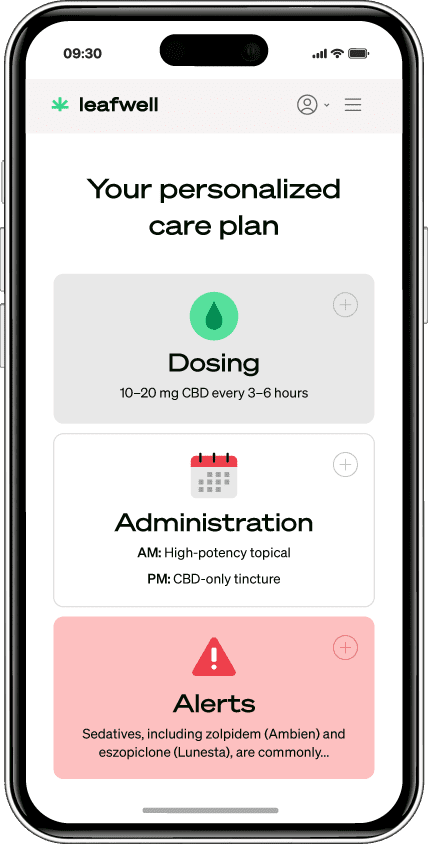
Cannabis — particularly CBD — is metabolised by the cytochrome P450 enzyme system and can interact with benzodiazepines, Z-drugs (zolpidem/Ambien, eszopiclone/Lunesta), antidepressants, and antihistamines. Combining cannabis with CNS depressants can amplify sedative effects. Always disclose all medications at your Leafwell appointment.
Insomnia may qualify you for a medical cannabis card.
See if you qualify in your state — most approvals completed same day.
- ✓Get approved in minutes
- ✓Same-day appointments available
- ✓Money back guarantee
Choosing cannabis products for insomnia
Rather than strain names, clinical importance centers on cannabinoid profile, delivery method, and timing.
- Sublingual tinctures (onset 15–45 min, duration 4–6 hrs): Best for sleep onset; precise titration.
- Oral edibles/capsules (onset 45–120 min, duration 6–8 hrs): Best for sleep maintenance — mid-night waking.
- Vaporized flower (onset 5–15 min, duration 2–3 hrs): Fastest relief for sleep onset; shorter duration.
- THC:CBN ratios: CBN is emerging as a sleep-specific cannabinoid; edible THC:CBN combinations are increasingly available.
Responses vary from person to person, which is why individualized medical guidance is recommended before starting cannabis for insomnia. For a closer look at specific cultivars patients discuss, see our guide to the best strains for insomnia.
Insomnia and medical marijuana eligibility by state
Insomnia qualifies for a medical marijuana card by name in only a few places — New Mexico and Puerto Rico list it directly, and New Hampshire recognizes moderate to severe insomnia as a qualifying symptom alongside a listed diagnosis. In roughly fifteen more states, a licensed provider may certify any condition they determine may benefit. Everywhere else, patients qualify through a related diagnosis such as PTSD, anxiety, or chronic pain.
| State | Insomnia qualifying? | How to qualify |
|---|---|---|
| Alabama | Not directly | Via PTSD or chronic/intractable pain (closed list; documented treatment failure required) |
| Alaska | No | Insomnia not listed and no sleep-related symptom route |
| Arizona | Not directly | Via PTSD or severe and chronic pain |
| Arkansas | Not directly | Via PTSD or intractable pain |
| California | At provider’s discretion | Physician may certify any condition cannabis provides relief for |
| Colorado | Not directly | Via PTSD, severe pain, or a condition for which an opioid could be prescribed |
| Connecticut | Not directly | Via PTSD or a listed chronic-pain condition |
| Delaware | At provider’s discretion | Practitioner may certify any condition with palliative or therapeutic benefit |
| Florida | Not directly | Via PTSD or a condition “of the same kind or class” as those listed |
| Georgia | Not directly | Via PTSD or intractable pain (closed list) |
| Guam | Not directly | Via a comorbid condition such as PTSD |
| Hawaii | At provider’s discretion | Since Act 241 (2025), a provider may certify any diagnosed condition |
| Illinois | Not directly | Via PTSD, chronic pain, or migraines (all listed); Opioid Alternative route for 21+ |
| Iowa | Not directly | Via PTSD or chronic pain |
| Kentucky | Not directly | Via PTSD or chronic, severe, intractable pain |
| Louisiana | At provider’s discretion | Any condition the clinician considers debilitating to the individual patient |
| Maine | At provider’s discretion | Certifying provider decides; no fixed list |
| Maryland | Not directly | Via PTSD, chronic pain, or the severe treatment-refractory condition catch-all |
| Massachusetts | At provider’s discretion | “Other debilitating conditions” as determined in writing by the provider |
| Michigan | Not directly | Via PTSD or severe and chronic pain (no catch-all) |
| Minnesota | At provider’s discretion | Practitioner catch-all; obstructive sleep apnea is separately listed |
| Mississippi | Not directly | Via PTSD or pain unresponsive to opioid treatment |
| Missouri | At provider’s discretion | Physician may certify any other chronic or debilitating condition |
| Montana | Not directly | Via PTSD or severe chronic pain (no catch-all) |
| Nevada | Not directly | Via an anxiety disorder (listed) or severe/chronic pain |
| New Hampshire | Yes — as a symptom | “Moderate to severe insomnia” qualifies alongside a listed diagnosis; GAD, PTSD, and chronic pain are stand-alone routes |
| New Jersey | Not directly | Via anxiety, PTSD, chronic pain, or migraine (all listed) |
| New Mexico | Yes — listed directly | Insomnia is an approved condition |
| New York | At provider’s discretion | Provider may certify any condition deemed suitable |
| North Dakota | Not directly | Via anxiety disorder or PTSD (both listed); no catch-all |
| Northern Mariana Islands | Not directly | Via a comorbid condition such as PTSD |
| Ohio | Not directly | Via PTSD or chronic, severe, or intractable pain |
| Oklahoma | At provider’s discretion | No fixed list; physician certifies |
| Oregon | Not directly | Via PTSD or a condition producing severe pain (symptom route) |
| Pennsylvania | Not directly | Via anxiety disorders, PTSD, or severe chronic/intractable pain (all listed) |
| Puerto Rico | Yes — listed directly | Insomnio is on the Department of Health condition list |
| Rhode Island | Not directly | Via PTSD or severe debilitating chronic pain |
| South Dakota | Not directly | Via PTSD or severe debilitating pain |
| Texas | Not directly | Via PTSD or chronic pain (Compassionate Use Program; closed list) |
| US Virgin Islands | Not directly | Via PTSD or provider’s therapeutic-benefit judgment |
| Utah | Not directly | Via PTSD or persistent pain lasting longer than two weeks |
| Vermont | Not directly | Via PTSD or chronic pain (3-month provider relationship required) |
| Virginia | At provider’s discretion | Practitioner may certify any diagnosed condition |
| Washington | Not directly | Via PTSD or intractable pain (closed list) |
| Washington D.C. | At provider’s discretion | No fixed list; adults 21+ may self-certify |
| West Virginia | Not directly | Via PTSD or severe chronic/intractable pain |
Note: Qualifying conditions change; confirm current rules during your Leafwell evaluation. States without active medical programs (Idaho, Indiana, Kansas, North Carolina, South Carolina, Tennessee, Wisconsin, Wyoming; Nebraska’s program is still being implemented) are not listed.
How patients with insomnia access medical cannabis
- Medical evaluation — A licensed provider reviews your insomnia diagnosis, symptom history, and current medications to determine if medical cannabis is appropriate.
- Certification if appropriate — If the provider determines cannabis may be beneficial, they issue certification under your state’s medical marijuana program.
- State registration — Patients complete registration with their state’s health department to obtain the medical marijuana ID card.
- Access regulated products — Once approved, patients purchase lab-tested cannabis from licensed dispensaries with clearly labeled THC and CBD levels.
Insomnia may qualify you for a medical cannabis card.
Living with insomnia? Get your medical cannabis card online in minutes — with larger purchase limits and up to 40% in tax savings.
- ✓Get approved in minutes
- ✓Same-day appointments available
- ✓Money back guarantee
Medical cannabis helped Carla reclaim her sleep.
From melatonin to weighted blankets, nothing helped Carla sleep through the night — until she tried medical cannabis.

“Getting better sleep has changed my life. I don’t know why I waited. I love that I don’t wake up groggy in the morning.”
Carla, Leafwell patient since 2023 *name and photo changed for privacy
A cannabis care plan, tailored to your needs
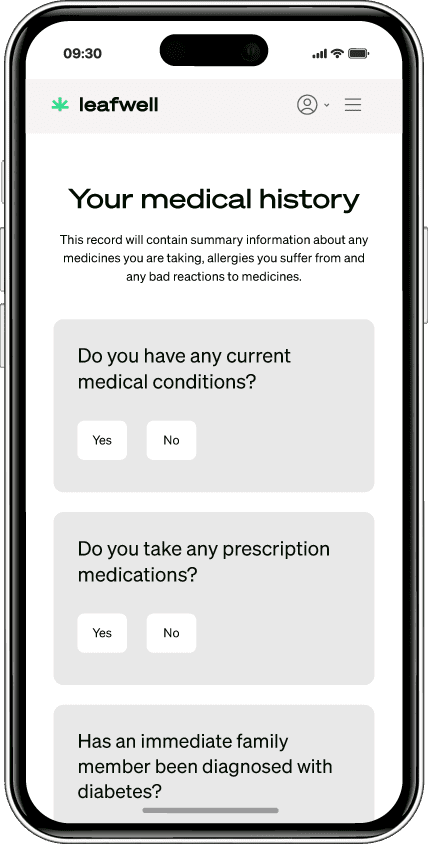
We’ve made it simple to get personalized guidance from a cannabis-knowledgeable pharmacist — no medical card required.
Frequently asked questions
Can you get a medical cannabis card for insomnia?
It depends on your state. New Mexico and Puerto Rico list insomnia directly, and New Hampshire recognizes moderate to severe insomnia as a qualifying symptom alongside a listed diagnosis. In roughly fifteen states, a licensed provider may certify any condition they determine may benefit. In most others, the condition driving your insomnia — PTSD, anxiety, or chronic pain — is the practical qualifying route. A Leafwell provider can tell you how insomnia is handled in your state.
Can medical cannabis help with insomnia?
Insomnia and sleep disorders are among the most common reasons patients seek medical cannabis. Research suggests THC-containing products may reduce the time it takes to fall asleep and decrease nighttime awakenings, while CBD may help with anxiety-driven insomnia. Responses vary, which is why physician guidance on product and dose matters.
Does CBD or THC help more with sleep?
THC tends to be more immediately effective for sleep onset, while CBD may be better for addressing anxiety-related insomnia. Long-term heavy THC use can disrupt sleep architecture — particularly REM sleep — so many providers recommend low doses or cycling. A balanced approach is usually best for sustained benefit.
Will I develop a dependence on cannabis for sleep?
Cannabis dependence is possible with heavy, long-term use. Some patients report REM rebound (vivid dreams) when stopping after regular use. A Leafwell provider can help you develop a responsible dosing strategy that minimizes dependence risk while optimizing sleep outcomes.
Is medical cannabis safe to use alongside sleep medications?
Cannabis can interact with benzodiazepines, Z-drugs (zolpidem/Ambien, eszopiclone/Lunesta), antidepressants, and antihistamines — amplifying sedative effects. It’s important to disclose all current medications to your Leafwell provider so they can assess safety and make appropriate recommendations.
Which states list insomnia as a qualifying condition?
Only New Mexico and Puerto Rico list insomnia by name. New Hampshire covers “moderate to severe insomnia” as a qualifying symptom when it accompanies a listed diagnosis such as cancer, Parkinson’s disease, or traumatic brain injury. See the state table above for the route in every other state.
Can I qualify through PTSD, anxiety, or chronic pain instead of insomnia?
Yes — in most states where insomnia alone doesn’t qualify, PTSD, anxiety (where listed), or chronic pain are accepted qualifying conditions that commonly underlie insomnia. For most of the country, these are the practical routes to certification for insomnia patients.
How do I get a medical card for insomnia online?
Select your state, complete a video evaluation with a licensed Leafwell physician, and if approved you receive your certification the same day. Most patients complete the process in under 30 minutes.
Take a gentler, more natural path to restful sleep
Begin your journey now — schedule a physician consultation today and get approved in minutes.
References
- Shannon S, et al. (2019). Cannabidiol in Anxiety and Sleep: A Large Case Series. The Permanente Journal, 23, 18–041. doi:10.7812/TPP/18-041
- Vaillancourt R, et al. (2022). Cannabis use in patients with insomnia and sleep disorders. Canadian Pharmacists Journal. doi:10.1177/17151635211061775
- Babson KA, et al. (2017). Cannabis, Cannabinoids, and Sleep: a Review of the Literature. Current Psychiatry Reports, 19(4), 23.
- Turna J, et al. (2020). Associations between cannabis use and health outcomes in people living with insomnia. Psychopharmacology. doi:10.1007/s00213-020-05476-1